-
Stored Sunshine
I like to imagine what our existence would look like if energy supply was unlimited both in amount and accessiblity. Imagine the ubiquity of air, but with readily convertible energy. Not the meager combustion-based energy sources we use today, but something orders of magnitude more powerful. Think controlled fusion, matter-antimatter annhiliation, or simply harnessing the energy output of the sun. Such forces are common in the universe—perhaps even ubiquitous. We only lack the means to tap them.
If we did tap them, we would conceivably enter a post-scarcity society. One way of looking at human activity, and our struggles, is to see it in terms of energy needs. Food is energy supply. Transportation is the conversion of an energy source in to kinetic energy. Energy supply governs manufacturing, which produces our buildings, healthcare equipment, and infrasturcture. Space travel is severely limited by energy demands.
With some reflection and imagination, you can develop a list of constructive pursuits that would grow in exciting ways if way more energy was available.
Richard Feynman had a knack for providing accessible explanations of complex subjects. The video above is one of my favorites, in which he describes what’s going on at the molecular level in a campfire. This one lodged in my head. The energy source for nearly all our activities traces back to sunlight.
- Our bodies. This energy works just like the campfire in the video above, but slower, and with some more steps in the chain reaction. But we’re basically just unlocking the energy of sunlight which plants captured.
- Hydro electric. The sun evaporates water, increases its elevation, and the water eventually flows downhill through a generator.
- Wind farms. Sun adds energy to the air, and the air moves around.
- Solar panels. I don’t know how these work! But the sun is right there in the name.
When an issue at hand is too complicated or troubling to absorb, my mind now deconstructs it in terms of its energy profile. This happens to me all the time. Elevators, coffee machines, computer networks, conferences. What is their energy budget, where did the energy come from, and what were all the various paths of its flow to reach the result?
- Orbital mechanics. How much mass is involved, what’s the velocity it needs to reach, and what’s the enegy source for making changes? With unlimited energy, we could go anywhere.
- War in the Ukraine. Where will they get the energy needed to move people, and materiel? How densely can they store energy in propellants and explosives?
- Superhero movies. Where do Superman or Cyclops get the energy for their eye lasers? Did they carb load at breakfast? Do they make nuclear fusion in their faces?
What could we do with unlimited energy?
I recently learned that it’s theoretically possible to create a “baby universe” 1. It would detach from our universe, and then continue on its own course, with its own laws of physics, forever separate and unreachable to us. It’s estimated that this could require as little energy as the equivaent of about 10kg of matter. Even though we’re nowhere near having the technology to accomplish such a thing, 10kg of matter seems surprisingly cheap for making a universe.
-
Existential Physics: A Scientist’s Guide to Life’s Biggest Questions, Sabine Hossenfelder, 2022 ↩
-
Pommes Débauchées
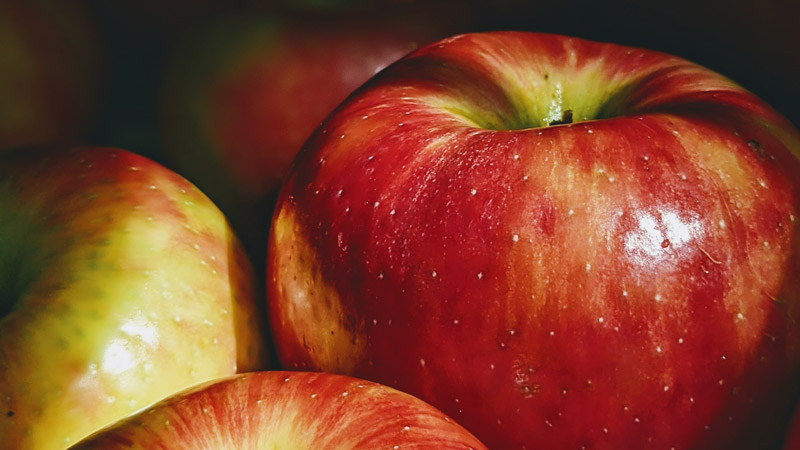
My go-to apple is Honeycrisp. They consistently deliver an ideal apple experience. As far as I can tell, other varieties are in the grocery only for baking, saucing, or to fill up space to justify the produce department setting aside a display bunker just for apples.
I’m joking, but only to poke fun at myself. I’m swarmed by biases like the one above. Apples might be trivial. But these “pre-filtered” perspectives keep showing up, and often in connection with much more consequential subjects, such as relationships, morality, finances, or thermostat settings. It’s at the point where I doubt nearly all the convictions my younger self held. I’m told this is a common experience among my age peers, so I keep moving through the fog.
Anyhow, recently while playing Fortnite with a friend, I felt like having a snack. I grabbed an apple.
When you play games like Fortnite along with friends, everyone wears a headset with a microphone, so that you can talk to each other. (Talking to your friends is the main point of the activity, but that’s another story.)
With my microphone on, my friend clearly heard that Honeycrisp apple crunch. Wikipedia helps illustrate what he heard:
It has larger cells than most apple cultivars, a trait which is correlated with juiciness, as theoretically a higher number of cells rupture when bitten, releasing more juice in the mouth.
“What kind of apple is that?”
“Honeycrisp, of course,” I said.
“My wife won’t let me buy Honeycrisps. They’re too expensive. I get Granny Smith.”
That caught me by surprise. I never even shopped around for apples. Eons ago, in the bewildering innocence of my youth, I’d buy Red Delicious apples because of the word “delicious”. They’re not delicious. They’re more like “Red Okay”.
Granny Smith, being tart and slightly mealy, are great for pies. Their potential comes out when combined with a cup of brown sugar, and a stick of butter. They’re the apples my grandma specified when she taught my cousins and me her apple pie recipe. They are literally grandma apples. (Her pies were perfect, and she was one of the most beautiful souls I’ve ever met.)
About ten years ago, someone told me I should be getting Honeycrisp apples. This had immediate appeal, as the words “honey” and “crisp” are more compelling than the word “delicious”. I got myself a bag of them at the grocery next door, and was all-in after one bite.
Ten years later, my friend had unwittingly pointed out that I’d acquired a high-end apple habit. Does my preference in apples point to yet another shortcoming in my character? I checked out “profligate apples” in French using Google Translate (French word sounds are cool). This was a great idea, because that produced the translation “pommes débauchées”. I don’t know what that would mean to someone who speaks French, but being an American living in Canada, my strategy for French is, of course, to transliterate it back to English. I’m amused by the idea of apples being so intensely pleasant that enjoying them could be debaucherous.
I don’t yet know where I am on the question of apples, and their role in revealing moral excess. Well, I do partly know. I’m going to keep buying Honeycrisp apples.
But it has me thinking about ways in which I get used to things without always considering their cost. How do I get off my mental train tracks, and really see what’s going on around me? How can I uncover and learn from what other people are experiencing? How can I start to notice and appreciate the choices I’m making all the time, when I’m not even aware that I’m making them?
(Photo by Adam Bouse on Unsplash)